Rabail Qayyum, Outgoing Graduate Co-Editor
Abstract
As my nearly four-year term as a graduate co-editor with The Peer Review (TPR) is coming to an end, I considered it an opportunity to assess the journal’s contribution to the field in some way. Through brainstorming ideas with the rest of the editorial team, I decided to identify and track key themes addressed in TPR articles, exploring main topics of conversation that we have published during this time; in essence tracing the themes that I helped give voice to through my role. Given the significance of timely review of scholarship to take stock of the field, in this article, I present a brief content analysis of selective scholarship published in TPR journal in an approximately two-and-a-half-year period ranging from Winter 2023 to Fall 2025. This content analysis is meant to highlight popular thematic trends. I identified a total of 14 themes in 27 articles published in four regular issues. From this small data set, tutor professional development emerged as the predominant theme. More than half of other themes—such as institutional assessment, oral histories, and African American writers, among others—appeared just once. Given that the journal places a concerted effort to welcome and support emerging voices in the field, these findings not only shine a light on what is worthwhile to this group but also points to where the field is likely headed (presuming these authors continue to grow and publish). I hope both new and established scholars will turn to this analysis when writing new articles or designing new studies. Journal editors may also find this analysis relevant to understand broad publishing trends.
Introduction
In the time of our editorial team, under the leadership of Genie Giaimo, TPR published a total of nine issues, including four (special or featured issues), and one summer reading supplement consisting solely of book reviews. The special category issues focused on the broad themes of artificial intelligence (a two-part issue), linguistic justice, and writing center commonplaces. The remaining four regular issues contained 29 individual publications in total. My overarching goal was to perform a thematic review of these regular issues because articles in special issues are already grouped thematically and so, I believed, analysis of the regular issues, where authors are free to send in scholarship on any topic, would be a more accurate representation of the scholarship that was published. Therefore, the goal of this content analysis was anchored on the following two questions:
Q1. What are the conversations published by TPR from Winter 2023 to Fall 2025?
Q2. What is the range and frequency of the themes being explored in the four regular issues of TPR from Winter 2023 to Fall 2025?
Method
My analysis comprised two steps. I first compiled all the individual entries in these issues from issue 7.1 up to issue 10. This step yielded a list of 29 entries. All these submission types were articles that could be analyzed thematically except for two: a book review and a meta-analysis of research methods. I excluded both from my analysis because I felt these two forms of writings contrasted strongly with other article types and prevented a straightforward thematic analysis. I then analyzed this data set consisting of 27 remaining articles. I came up with broad classifications and coded each article under one category for ease of comparison. In cases where the manuscripts did not carry key words, I paid attention to their titles and introductory paragraph(s) to interpret the themes. In some cases, it was difficult to classify an article under only one category. For instance, the article “Student-Consultant Interactions: From Single Visits to Partnerships” could be categorized under both tutor practices and tutor professional development, but I placed it under tutor practices because the goal of the paper seemed better aligned with this theme. In this way, I developed a coding scheme that allowed me to capture all articles.
Findings
Table 1 below presents an analysis of the themes that were covered in the four regular issues.
Table 1
Frequency of Broad Themes in TPR Publications
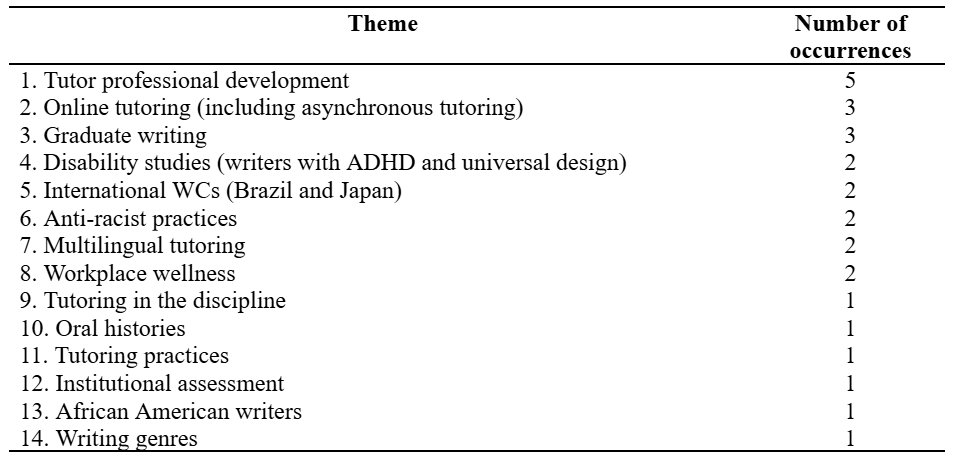
Table 1 reveals that tutor professional development was the theme that was most frequently covered by journal contributors. This theme was followed by online tutoring (including asynchronous tutoring) and graduate writing. In third place were themes of disability studies, international WCs, anti-racist practices, multilingual tutoring and workplace wellness. The remaining themes were tutoring in the discipline, oral histories, tutoring practices, institutional assessment, African American writers, and writing genres. These six themes were all addressed once and thus emerged as areas of focus for scholarship in the field, especially among emerging scholars.
Discussion and Conclusion
Adopting the technique of content analysis to better understand what is being discussed in the regular issues of TPR, this paper provides a glimpse into the publishing landscape. It offers a starting point for determining what is considered important in recent published scholarship and can influence researchers’ and editors’ decision-making.
The higher frequency of the tutor professional development theme reflects that tutor development is a topic that holds currency with TPR’s readership which can be leveraged by authors facing difficulties in deciding what to write about. The themes that were covered once illustrate that these are topics of interest to the field that have room for further contribution. This finding may assist researchers, especially emerging scholars, to become aware of subjects to tackle, thereby putting their work at the center of current scholarship. This heterogeneity also reflects the breadth of scholarship that authors chose to broach different topics.
I hope the next editorial team can build upon this limited analysis by looking at different questions like the citation metrics of published articles, or how much of the scholarship was produced by undergraduate and/or BIPOC scholars. I believe that additional concrete evidence about who gets published will, apart from improving the substance of the publications, also improve future reviews. At the moment, TPR does not gather information on contributing authors’ academic levels (e.g., undergrad or grad students) or institutional contexts (e.g., Hispanic-serving institutions), but the incoming editorial team can consider developing mechanisms that do so. A new line of inquiry could then be pursued with this data. For example, is it current undergraduate peer tutors mostly attending to the theme of tutor professional development? Is there a correlation between online tutoring conversations and institution type/context (i.e., public vs private, HBCUs etc.)? Consequently, it would expand scholarship on the new voices that are entering our field, fulfilling the goal of TPR as stated on its website and in its bylaws. All in all, such reviews are essential to take stock of what is published, identify popular research topics, and tie them together into a ‘big picture.’
At the end, as I look back on these last few years, my heart is filled with gratitude. I wish to thank the rest of the editorial board members for inspiring me with their talent and work ethic. As an international graduate student embarking on my PhD journey at the time of the COVID-19 pandemic, this opportunity to work as a graduate co-editor was rewarding in so many ways. Studying in Hawai’i, I could work with wonderful people located primarily on the East Coast, and learn all about writing, mentoring, peer reviewing, and editing. This role afforded me the privilege of attending my first-ever IWCA conference in Baltimore fully supported by the IWCA through the journal. In my time at TPR, I saw my role get clearer (e.g., the workload getting fairly divided) and many processes get more streamlined (e.g., efficiently managing the manuscripts). As a scholar in the field, I have definitely developed my critical thinking skills and grown in confidence in voicing my opinions. I am also grateful to all of our collaborators who chose our journal to publish their work or review the scholarship we published. I wish the incoming editorial team well as they start their journey and am excited to see where they take the journal next.